Ethics: Origin and Development by Kropotkin Peter
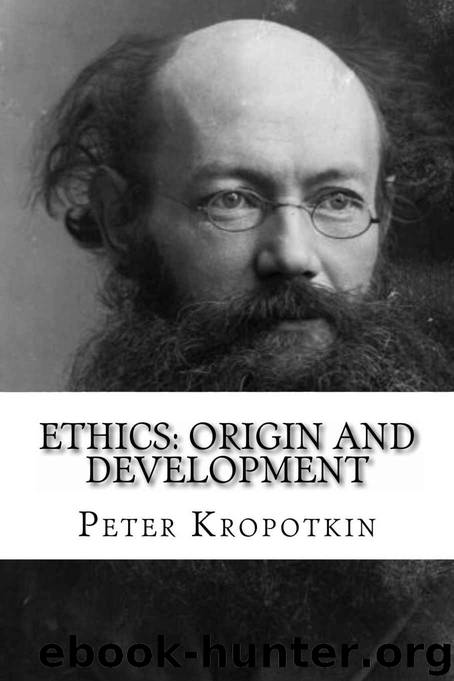
Author:Kropotkin, Peter [Kropotkin, Peter]
Language: eng
Format: epub
Published: 2012-08-15T00:00:00+00:00
Chapter 9: Development of Moral Teachings in the Modern Era (End of 18th century and beginning of 19th century)
As was pointed out in the preceding chapter, the teachings of the French philosophers of the eighteenth century — Helvétius, Montesquieu, Voltaire, of the Encyclopædists Diderot and d’Alembert, and of Holbach, — played an important part in the history of the evolution of Ethics. The bold denial by these thinkers of the importance of religion for the development of the moral conceptions, their assertions of equity (at least political), and, finally, the decisive influence in the elaboration of social forms of life credited by most of these philosophers to the rationally interpreted emotion of self-interest — all these factors were Very important in forming correct conceptions of morality; and they helped to bring society to the realization of the fact that morality can be completely liberated from the sanction of religion.
However, the terror of the French Revolution, and the general upheaval that accompanied the abolition of feudal rights, and also the wars that followed the Revolution, compelled many thinkers to seek once more the basis of morality in some supernatural power, which they recognized in more or less disguised form. The political and the social reaction were paralleled in the realm of philosophy by a revival of metaphysics. This revival began in Germany, where at the end of the eighteenth century appeared the greatest German philosopher, Immanuel Kant (1724–1804). Kant’s teaching is on the border line between the metaphysical philosophy of earlier times, and the scientific philosophy of the nineteenth century. We will now briefly survey Kant’s moral philosophy.[163]
Kant’s aim was to create a rational ethics, i.e., a theory of moral conceptions entirely different from the empirical ethics advocated by most English and French thinkers of the eighteenth century. Kant’s ethical system was to bear the same relation to preceding theories, as theoretical mechanics bears to applied mechanics.
The aim set by Kant was, of course, not new. Almost all thinkers preceding Kant made the endeavour to determine the rational bases of Ethics. But, contrary to the English and French thinkers of the seventeenth and eighteenth centuries, Kant intended to discover the fundamental laws of morality not through study of human nature and through observation of life and the actions of man, but through abstract thinking.
Reflecting on the basis of morality Kant came to the conclusion that it is found in our sense of duty. This sense of duty, according to Kant, originates neither from considerations of utility (whether individual or social) nor from a feeling of sympathy or benevolence; it is a property of human reason. According to Kant there are two kinds of rules of conduct that human reason can create; some of these rules are conditional, others are unconditional. For example: if you wish to be healthy — lead a moderate life: this is a conditional rule. A man who does not want to lead a moderate life, may choose to neglect his health. Such prescriptions contain nothing absolute, and man may or may not carry them out.
Download
This site does not store any files on its server. We only index and link to content provided by other sites. Please contact the content providers to delete copyright contents if any and email us, we'll remove relevant links or contents immediately.
| Anthropology | Archaeology |
| Philosophy | Politics & Government |
| Social Sciences | Sociology |
| Women's Studies |
The Secret History by Donna Tartt(19467)
The Social Justice Warrior Handbook by Lisa De Pasquale(12293)
Thirteen Reasons Why by Jay Asher(9118)
This Is How You Lose Her by Junot Diaz(7056)
Weapons of Math Destruction by Cathy O'Neil(6466)
Zero to One by Peter Thiel(5951)
Beartown by Fredrik Backman(5931)
The Myth of the Strong Leader by Archie Brown(5623)
The Fire Next Time by James Baldwin(5581)
How Democracies Die by Steven Levitsky & Daniel Ziblatt(5322)
Promise Me, Dad by Joe Biden(5229)
Stone's Rules by Roger Stone(5186)
A Higher Loyalty: Truth, Lies, and Leadership by James Comey(5085)
100 Deadly Skills by Clint Emerson(5023)
Rise and Kill First by Ronen Bergman(4890)
Secrecy World by Jake Bernstein(4877)
The David Icke Guide to the Global Conspiracy (and how to end it) by David Icke(4849)
The Doomsday Machine by Daniel Ellsberg(4619)
The Farm by Tom Rob Smith(4611)
